A food-ordering demo I built mostly as a test bench: to find out whether an Android build pipeline works, and to try out Three.js models. It is an older project that I never updated until I decided to put more of my work on GitHub.
It still does a surprising amount, so here is what is in it.
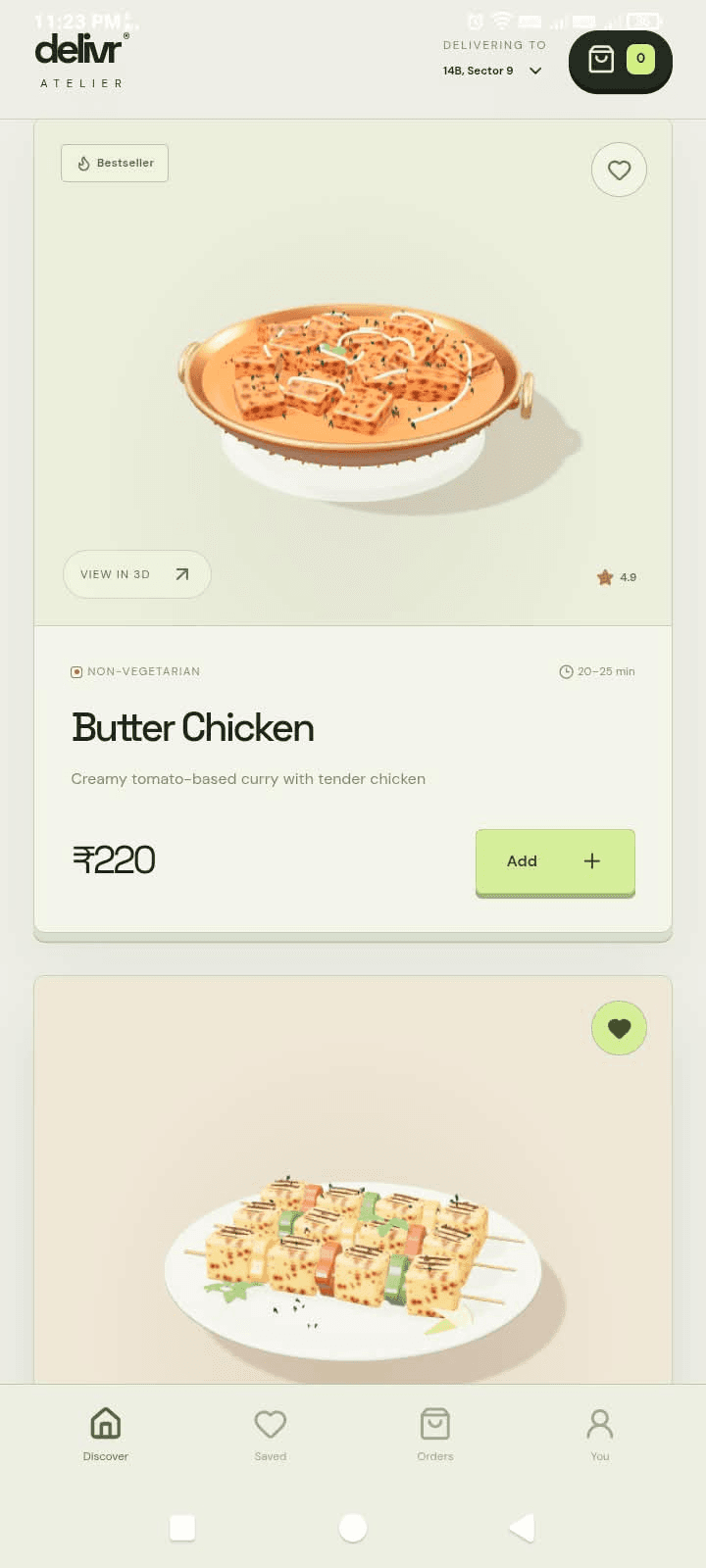
DiscoverThe menu: search, filters, ratings, a bag.
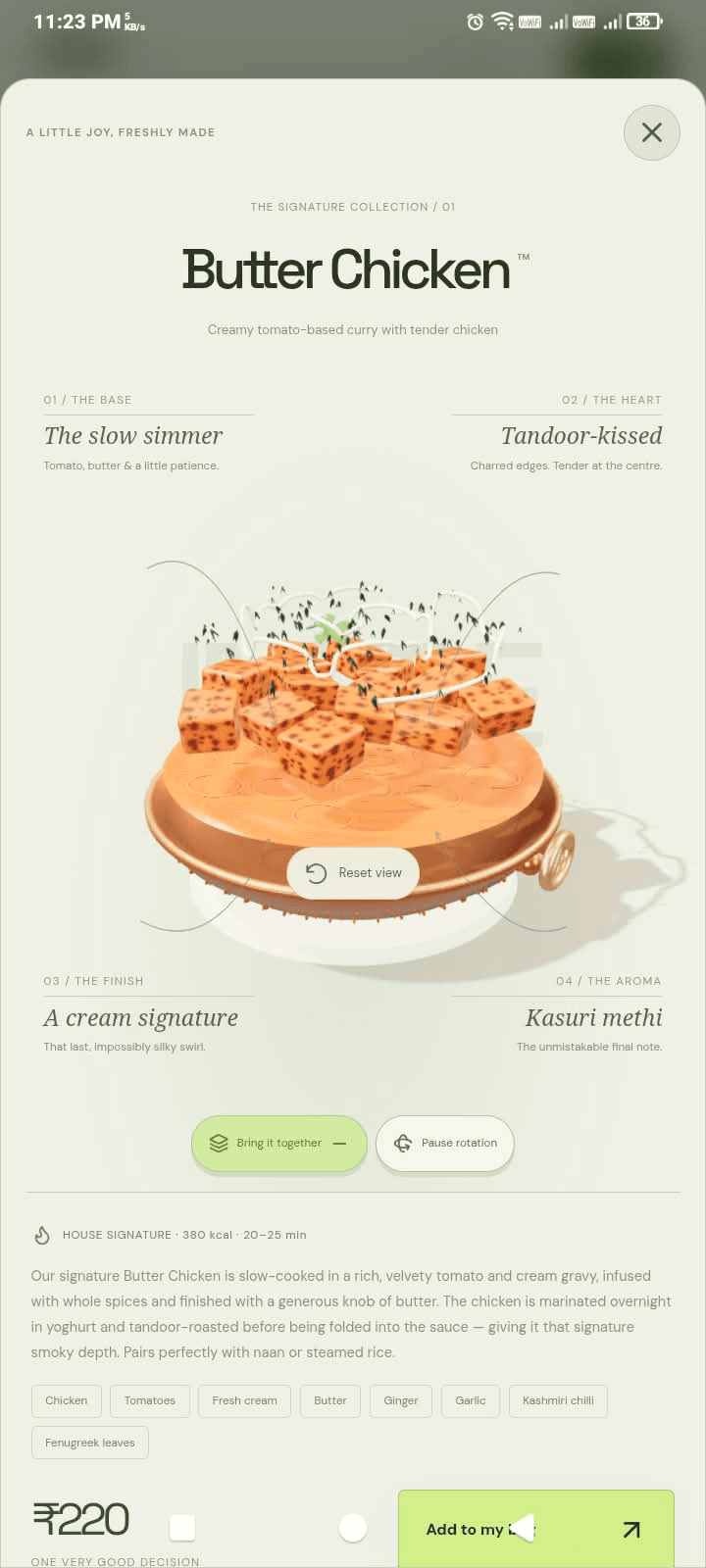
Dish inspectorOrbit a 3D dish and pull its ingredients apart.
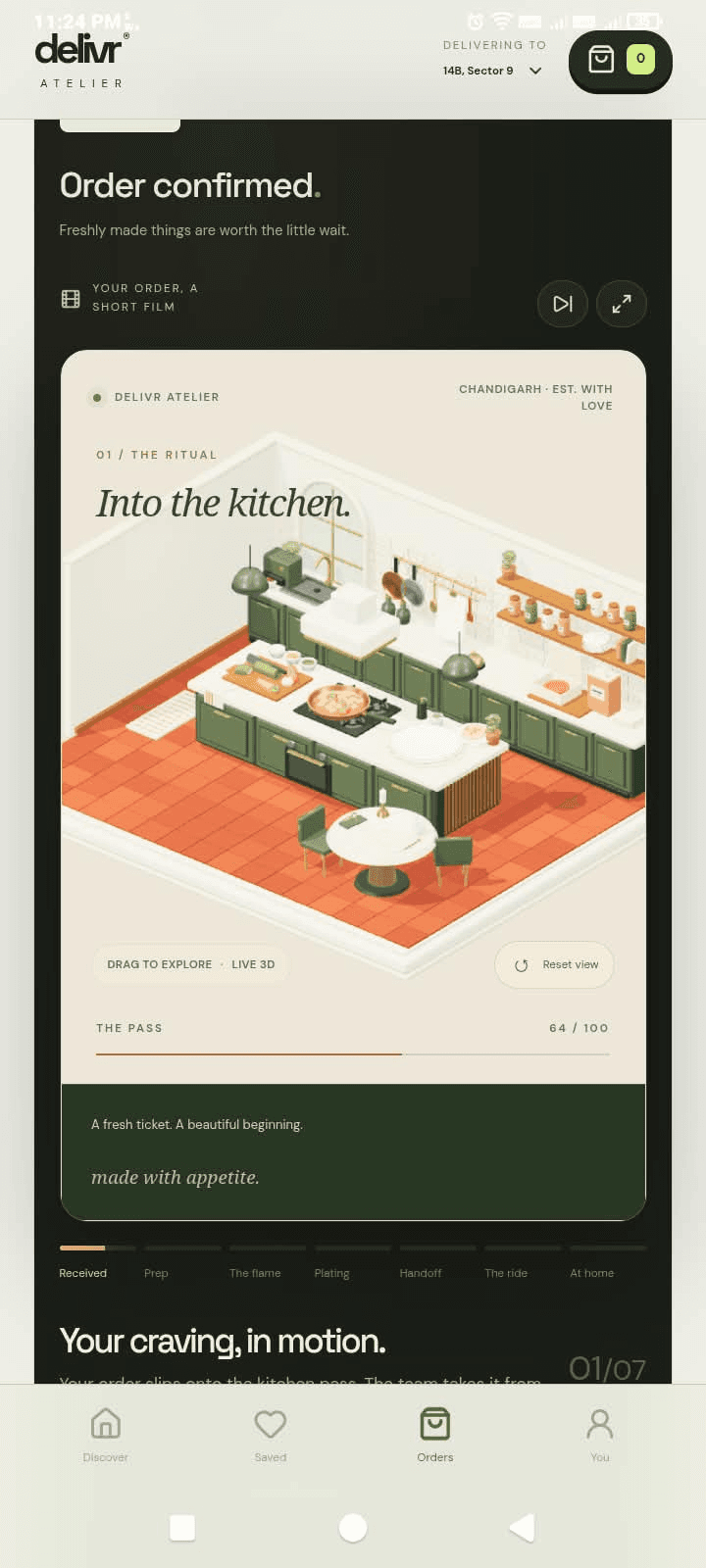
The kitchenAn order becomes a short film, scene by scene.
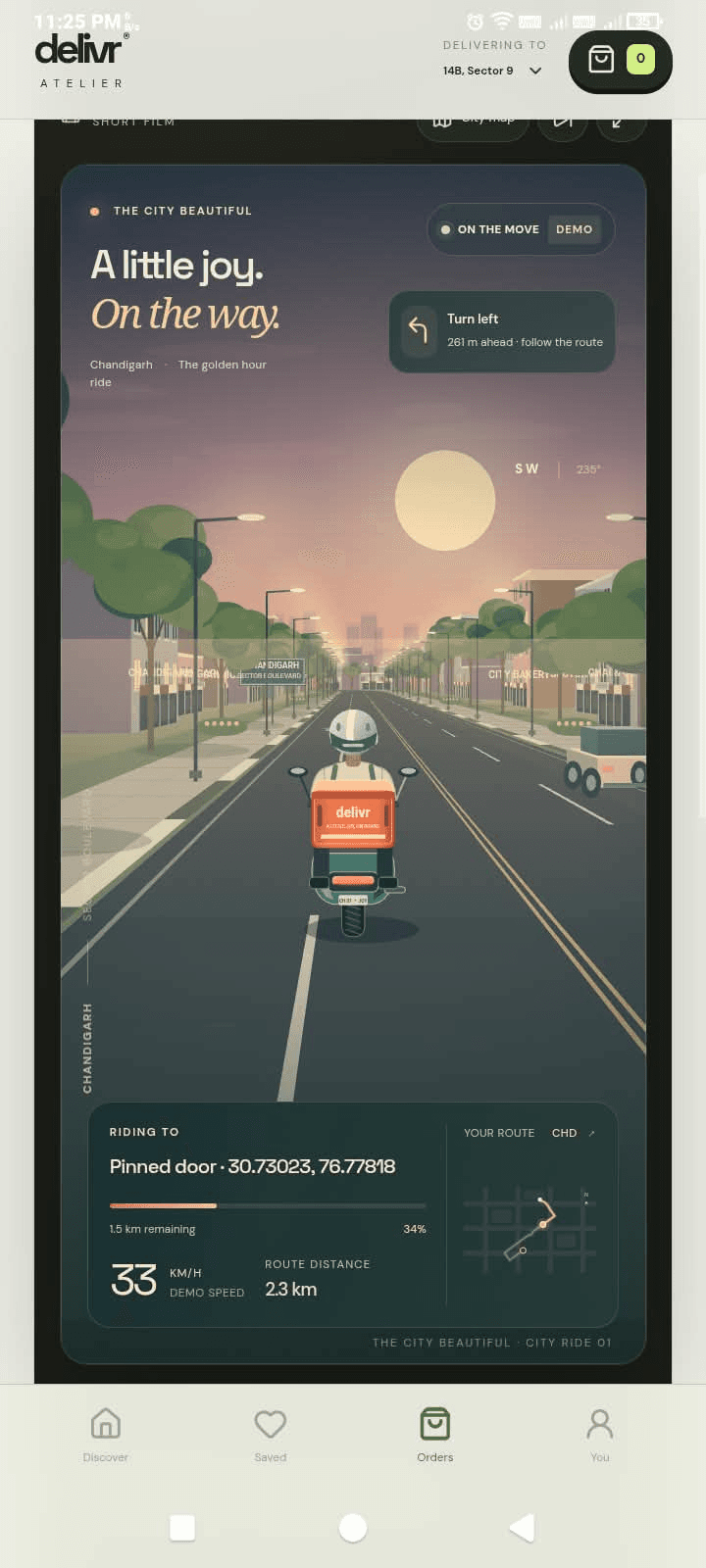
The rideA chase camera follows the route to your door.
01 / The point
What it was really for
Honestly, the food ordering is the excuse. The project exists to test two things end to end.
Testing the Android environment
A Capacitor project, with app id app.delivr.food, wraps the web app and is committed under android/. A GitHub Actions workflow runs the type check, the tests and the build, then assembles a debug APK and publishes it to a rolling “latest” release, so a phone can install it without any local toolchain.
Building locally needs Node 22, JDK 21 and the Android SDK (platform 36). The APK is debug-signed, for sideloading and testing only.
Testing Three.js models
Butter Chicken, Paneer Tikka and Chicken Biryani are procedural: geometry, materials and textures are generated in code, so nothing is downloaded. Open one to orbit it, zoom, or separate it into labelled ingredient layers.
On a phone, GPU use is kept bounded: capped pixel ratios, rendering paused when hidden, geometry, materials and textures disposed explicitly, and an illustrated fallback if WebGL is unavailable.
02 / How it grew
From a wireframe, to a storefront
A wireframeSeven static screens and no framework, just to settle where the cart lives and what a menu card shows.
The Atelier rebuildReact, TypeScript and Vite, with ivory paper, olive accents and restrained type; procedural Three.js dishes, a 3D kitchen and a chase-camera ride; an owner dashboard behind a demo login; and a typed reducer that validates anything restored from storage.
Android and CIA Capacitor project, a debug-APK workflow and a rolling release.
03 / The film
Your order, a short film
Placing an order starts a 3D film in seven scenes. You can pause, skip, replay, toss the pan, change the heat and lift the dining cloche.
Received
Prep
The flame
Plating
Handoff
The ride
At home
The ride follows a real road route on a Chandigarh map (OSRM for the geometry), with stylised procedural streets. Speed and progress are simulated.
04 / What is in it
A surprising amount, for a test
Browse and filterSearch, category and vegetarian filters, price and rating sorting, favourites, dish details and ingredient lists.
A bag with real rulesQuantity limits, unavailable dishes blocked, free delivery from ₹499 and a 20% code (HELLO20) capped at ₹100.
Checkout on a mapSearch a Chandigarh location, pick a landmark or drop a pin. The address and the pin are shown separately so you can check both.
An owner command centerBehind a demo login: period KPIs from the orders actually placed, inspectable charts, an order queue, availability switches and a Ctrl or Cmd + K palette.
Works offlineCaches itself after a visit, ships a web manifest and branded Android icons, and bundles twelve illustrated food fallbacks.
Gentle on motionEverything respects the reduced-motion preference, and the 3D scenes pause when they are off-screen.
141automated tests
33D dishes
7film scenes
0backends
STACK
Built with
Measured from the project's own source: 47 files.
TypeScript64.5%
CSS30.9%
JavaScript2.6%
Other2%
Libraries & tools
React
Vite
Capacitor
TypeScript
Three.js
Lucide
Vitest
android
react-dom
AppCompat
coordinatorlayout
core-splashscreen
05 / The honest part
What it is not
It is a local demo. There is no backend, no real sign-in, no payment and no dispatch, and orders stay in the browser's local storage on that device.
The owner login is a public demo gate, not security.
Address search, routing and map tiles use public Photon, OSRM and OpenStreetMap services with no availability guarantee. If routing is down, the app asks you to choose an illustrated direct path and labels it as one.
Speed, cooking and delivery progress are a simulation, and the buildings are stylised scenery, not a surveyed 3D model.
The Android build is a debug-signed APK for sideloading only. Visual checks across browsers and phones were still on the to-do list.